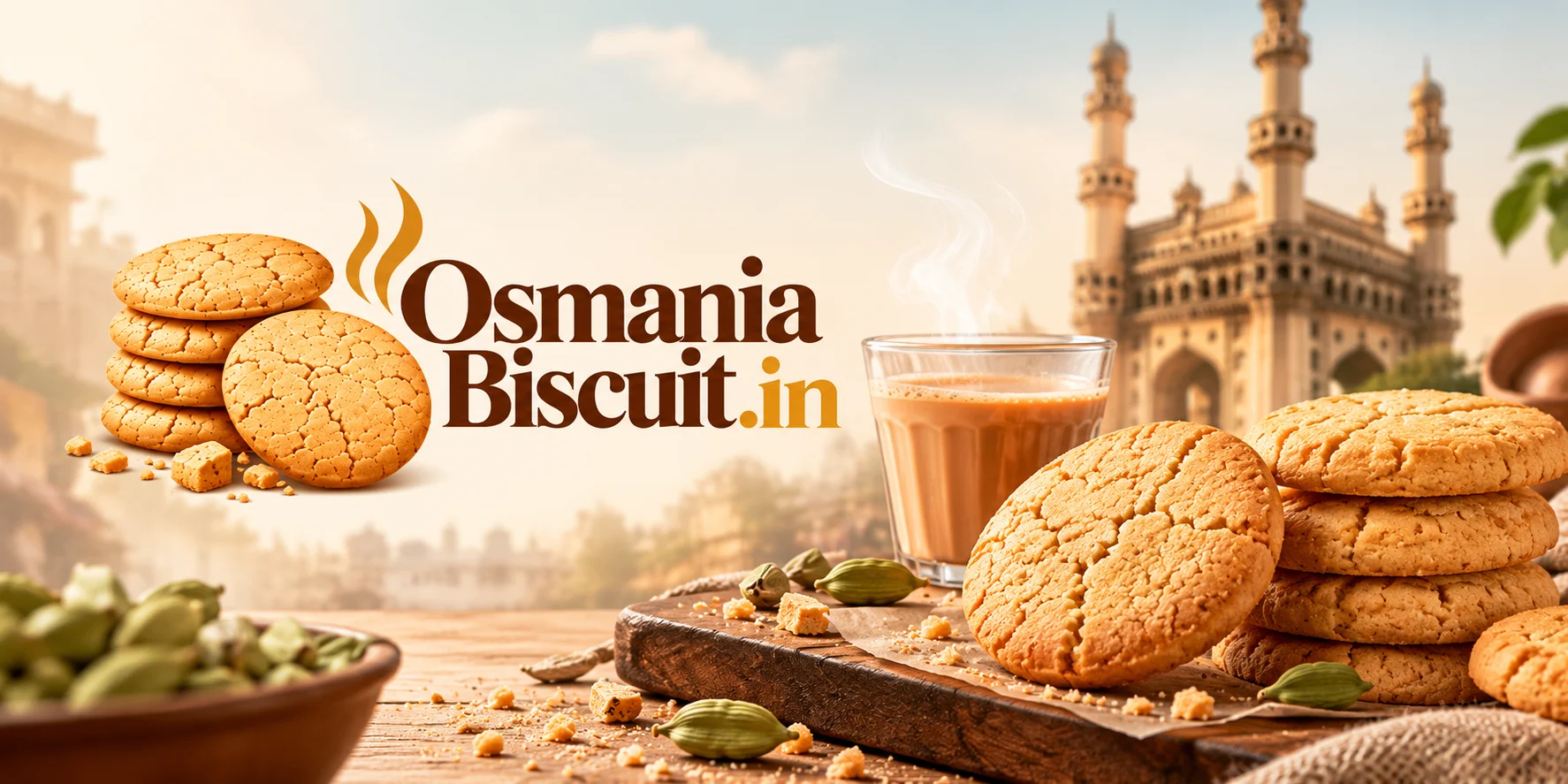
So, what is Osmania biscuit?
Osmania biscuit is Hyderabad’s classic tea biscuit: golden, crumbly and lightly sweet, with a pinch of salt that makes it taste different from most other biscuits.
It is made from a short list of ingredients: refined flour (maida), butter or ghee, sugar, milk and salt. Some versions add cardamom or saffron.
The name honours the seventh and last Nizam of Hyderabad, Mir Osman Ali Khan.
Ask a Hyderabadi what makes an evening complete and you will often hear the same answer: a cup of Irani chai and an Osmania biscuit. This guide explains what the biscuit is, how it got its name, what goes into it and how it differs from similar biscuits elsewhere in India.
Osmania biscuit at a glance
| Detail | Answer |
|---|---|
| Type | Tea biscuit (cookie-style snack) |
| Place of origin | Hyderabad, Telangana, India |
| Named after | Mir Osman Ali Khan, the last Nizam of Hyderabad |
| Cuisine | Hyderabadi |
| Flavour | Mildly sweet with a pinch of salt |
| Texture | Soft, crumbly, melts in the mouth |
| Main ingredients | Flour, butter or ghee, sugar, salt, milk (powder in many recipes) |
| Optional flavours | Cardamom, saffron |
| Classic partner | Irani chai |
| Calories | About 60 to 90 kcal per biscuit |
Recipes and sizes differ from one baker to another, so use the table as a guide.
Where does the name Osmania come from?
The name comes from the last Nizam, Mir Osman Ali Khan, who ruled Hyderabad state until 1948. His name is attached to several city landmarks, including Osmania University and Osmania General Hospital, and the biscuit carries it too. Wikipedia says the biscuit traces back to the Nizam’s royal kitchens, where he wanted a snack that blended sweetness and saltiness.
How exactly the biscuit got going is told in a few ways. None of them is backed by a document we could check, so we present them as the stories people tell.
The royal kitchen
Local historians quoted by The Federal say the Nizam asked his chefs for a light snack that was both sweet and savoury, and doctors supervised the recipe.
The hospital biscuit
In this version, patients at Osmania General Hospital were tired of milk and bread. The new biscuit was given to them alongside it for energy.
The favourite from Abids
Another account says the Nizam enjoyed biscuits from a popular restaurant on Abids, and the owners began calling them Osmania.
The Federal adds that the biscuit then moved from the palace kitchen to a bakery set up by the Nizam in Abids. Patients shared them with visiting family, word spread, and bakeries across the city took up the recipe.
A note on Wikipedia. Wikipedia also says Turkish and Persian baking customs influenced the biscuit. That claim is not backed by a source we could verify, so we treat it as a possibility, not a fact.
What does Osmania biscuit taste like?
Most biscuits lean sweet or lean savoury. Osmania sits in the middle. The sugar is gentle, the salt is just noticeable, and the butter or ghee gives a rich, milky finish. People who grew up with it describe the first bite as melting on the tongue.
The texture is more crumbly than crunchy. Recipe writers compare it to shortbread. Saffron or cardamom, when used, adds a light floral aroma that goes well with strong tea.
That sweet-and-salty balance is the reason the biscuit stands out, and it is the first thing to check if you are trying a new one.
What is Osmania biscuit made of?
There is no single official recipe, but the building blocks are simple and familiar. An IANS report lists maida, sugar, salt, milk powder, ghee and baking powder among the ingredients. Wikipedia lists milk, flour, cardamom, salt and sugar.
| Ingredient | Why it is there |
|---|---|
| Maida (refined wheat flour) | The pale, light base of the biscuit. |
| Butter or ghee | Richness and the melt-in-the-mouth crumb. |
| Sugar | Light sweetness and golden colour. |
| Salt | The savoury edge that makes Osmania different. |
| Milk or milk powder | A soft, milky flavour and good browning. |
| Baking powder | A little lift so the biscuit stays tender. |
| Cardamom or saffron | Optional aroma in some recipes. |
Some bakers use whole wheat flour, and many recipes are eggless, though this depends on the maker. For a deeper look, see our ingredients guide.
How Osmania biscuit is made
The method is short, which is part of the charm. The Federal reports that biscuits were once made by hand, and that machines are now common because demand is so high. Home bakers in the old city still make them too.
- Cream the fat and sugar. Butter or ghee is beaten with sugar until smooth and light.
- Add milk, salt and aroma. This is where cardamom or saffron goes in.
- Fold in the flour. Mix only until a soft dough forms. Handling it too much makes the biscuits tough.
- Shape the rounds. The dough is portioned into small discs and lightly flattened.
- Bake until golden. They come out pale gold and firm up as they cool.
Try it yourself with our step-by-step Osmania biscuit recipe.
Why Osmania biscuit and Irani chai belong together
Irani cafes began buying Osmania biscuits from bakeries to serve with tea, according to The Federal, and that is how the pairing took root. The logic is easy to taste. Irani chai is strong, milky and sweet, and a biscuit that is crumbly with a hint of salt cuts through it without competing.
It is also an affordable habit. In 2025, The Federal put an Osmania biscuit at about Rs 5 and a cup of Irani chai at about Rs 15 to 20 in Hyderabad. Local estimates cited in the same report say lakhs of Osmania biscuits are eaten in the city every day.
IANS reports that it is a favourite with young and old, a go-to treat for guests at home, and that sales rise in winter when people reach for hot tea. Today it is served at homes, tea stalls and cafes, given as a gift and carried by travellers, which is how the biscuit has spread well beyond Hyderabad.
Osmania biscuit vs similar biscuits
Wikipedia notes that Tamil Nadu has biscuits that look and taste similar, including the butter biscuit of Chennai and the Ooty biscuit. It adds that these developed on their own and do not share a cultural link with Osmania. Hyderabad also has its own family of local biscuits, with Khara, Chand, Fine and Tie biscuits among the long-standing favourites.
| Biscuit | How it differs from Osmania |
|---|---|
| Osmania | Hyderabad’s sweet-and-salty, crumbly tea biscuit. |
| Chennai butter biscuit | Closely resembles Osmania, but developed separately in Tamil Nadu. |
| Ooty biscuit | Made in a similar way, with its own local history. |
| Khara biscuit | A savoury Hyderabadi biscuit. |
| Chand biscuit | Named for its crescent moon shape. |
| Tie biscuit | Known for its bow-tie shape. |
| Marie biscuit | A thin, plain, dry tea biscuit. Crisper and much less rich than Osmania. |
How we judge a good Osmania biscuit
What we look for
- Pale golden colour, not dark brown.
- Crumbles softly when you bite, without being hard.
- A clear but gentle balance of sweet and salt.
- A buttery or ghee aroma, with cardamom or saffron if used.
- Fresh, not stale or oily.
What we avoid
- Very hard or chewy texture, which can mean overworked dough or age.
- Oily or stale smell.
- Too sweet, with no hint of salt.
- An ingredient list with hydrogenated fat if you want to avoid trans fat.
How to store it
Keep Osmania biscuits in an airtight container in a cool, dry place so they stay crisp and fresh. Always follow the best-before date on the pack.
Osmania biscuit calories and nutrition
A 15 g Osmania biscuit is listed at about 61 calories in published recipe nutrition data, with roughly 7.3 g of carbohydrate, 0.8 g of protein and 3.2 g of fat. Other sources put a biscuit at up to about 90 calories depending on size.
It is a treat rather than a nutritious snack, since it is made from refined flour and fat and has very little fibre. Read our guide Is Osmania biscuit healthy? for portion advice and the health scorecard.
Frequently asked questions
What is Osmania biscuit?
It is a soft, crumbly, sweet-and-salty tea biscuit from Hyderabad. It is made from flour, butter or ghee, sugar, salt and milk, and is named after the last Nizam, Mir Osman Ali Khan.
Why is it called Osmania biscuit?
It is named after Mir Osman Ali Khan, the last Nizam of Hyderabad. Stories differ on whether it began in his royal kitchen, at Osmania General Hospital or at an Abids restaurant he liked.
Who invented Osmania biscuit?
No single inventor is documented. It is traditionally linked to the Nizam’s royal kitchens and the bakeries that followed.
Is Osmania biscuit sweet or salty?
Both. It is lightly sweet with a pinch of salt, and that balance is its signature.
What is Osmania biscuit made of?
Typically flour, butter or ghee, sugar, salt and milk or milk powder, with baking powder in many recipes. Some add cardamom or saffron.
Is Osmania biscuit eggless?
Many recipes use no egg, but it depends on the maker. Check the ingredient list.
What is Osmania biscuit eaten with?
Irani chai is the classic partner. It is also nice with regular tea or coffee.
Is there a similar biscuit outside Hyderabad?
Yes. Tamil Nadu has similar biscuits, such as the Chennai butter biscuit and the Ooty biscuit, although they developed separately.
How many calories are in an Osmania biscuit?
About 60 to 90 calories per biscuit depending on size. A 15 g biscuit is listed at about 61 calories.
Is Osmania biscuit a cookie or a biscuit?
In India it is called a biscuit, which is the word used for what many countries call a cookie. It is a soft, shortbread-style bake, so it is closer to a cookie in texture than to a dry cracker-style biscuit.
Why do people eat Osmania biscuit with chai?
Irani chai is strong, milky and sweet. The crumbly biscuit with a hint of salt balances it without competing, which is why the pairing became a Hyderabad habit.
Is Osmania biscuit healthy?
It is an occasional treat, not a health food. See our full guide on Osmania biscuit and health for details.
Sources and further reading
Origin stories come from local tradition and press reporting. Nutrition figures vary by recipe and size.